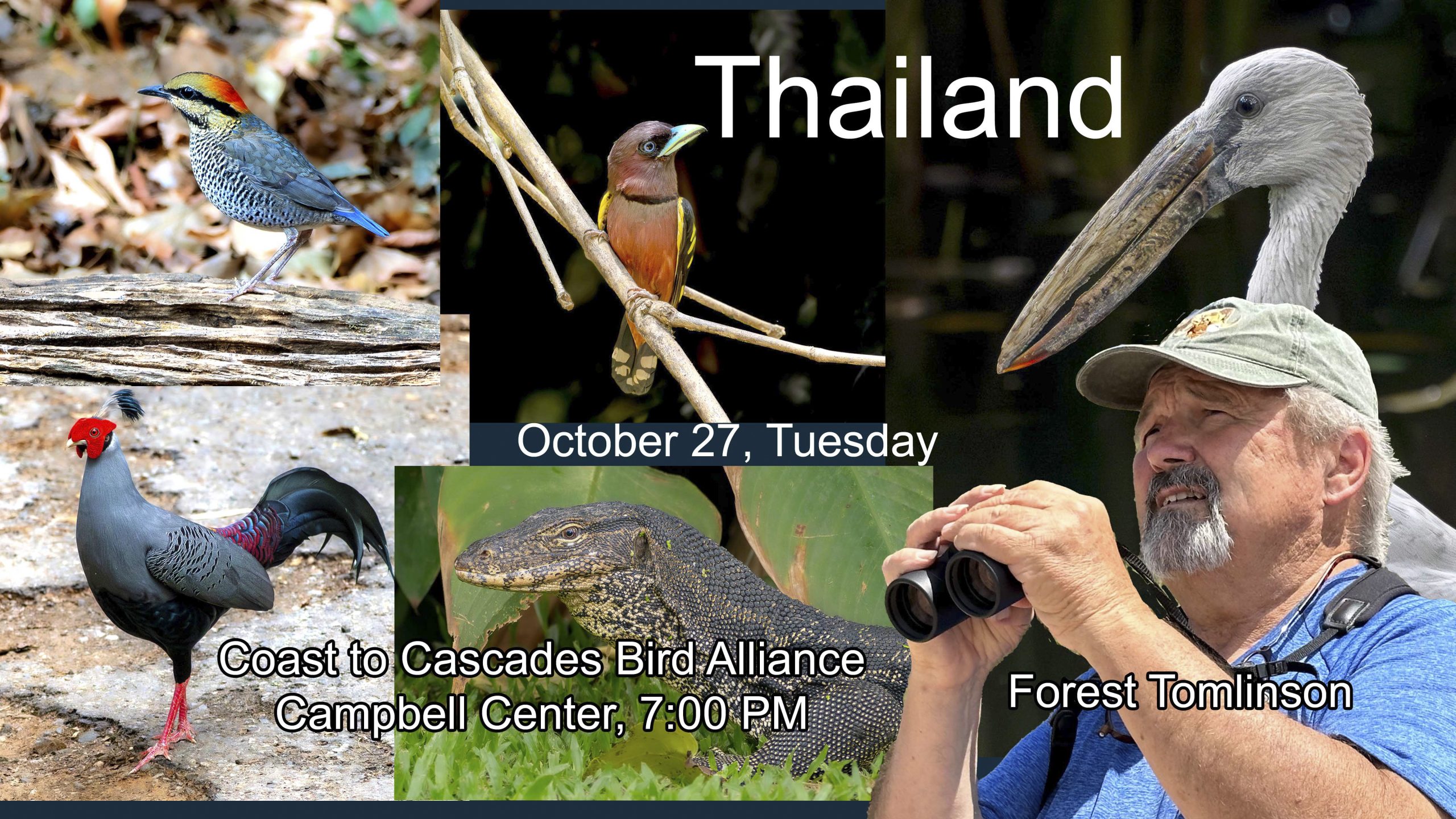
Join us for our Third Saturday Bird Outing, Oct 17, at Perkins Peninsula park. Details…

If you think a bird needshelp,assess the situation carefully before you act.Many wildlife species leave their young while they forage for food and won’t return if people are nearby. An animal should only be removed from its habitat when it’sabsolutely necessary.
If the bird is bleeding, has a weirdly angled limb, has suffered an animal attack or window strike, it needs professional care. In the Eugene/Springfield area, contact the Cascades Raptor Center (541-485-1320 ext. 2) for help or advice. If you’re closer to Corvallis, call Chintimini Wildlife Center’s hotline (541-745-5324).
Young Birds

Birds at different stages of growth need different kinds of help. Hatchlings and nestlings are sparsely feathered and unable to hold onto a branch. If found out of the nest, they need to be returned to it or placed in an artificial nest. (It’s a myth that parent birds will reject a chick that has been touched by a human.) Some birds naturally nest on the ground, while others nest in cavities in trees or buildings. It is crucial to correctly ID the species, which a certified wildlife rehabber can do. Send a photo or short video to help themidentify the bird and provide the best advice on how to find the nest.
If the nest can’t be located or has been destroyed, make one from a basket or a small plastic container with drainage holes.Line it with the remaining nest, moss, and dried grass, and tack it up (or place it on the ground) as near as possible to the original nest. Make sure the nest is not too deep, because the parents will be hesitant to fly into anything they can’t see out of. Closely monitor the nest from a distance for an hour or two;ifno parent comes back, the babies need to be taken to a rehabber.

Fledglings are young birds with some feathers. They are learning to fly but are still dependent on their parents. Unless visibly injured or weak, these birdsshould be left where they are;it’s likely that the parents are nearby and waiting for you to leave. However, baby birds have widely varied needs depending on their species. For example, young cavity-nesting birds, such as chickadees, woodpeckers, saw-whet owls, swallows, and swifts, should never be on the ground before they are fully flighted. Here again, sending a photo to a wildlife rehabber will get you the best information on how to help. If the fledgling appears to be in immediate danger, such as being exposed to predators or hot sun, you can move it to the nearest bush or tree.
Containing a Bird
Contain an injured or orphaned bird in a pet carrier or a clean, dry, covered box with holes in the lid. Line the boxwith paper towels or an old T-shirt (no stringy edges). It’s important to keep the bird warm (80-90 degrees). Use a heat pack wrapped in a towel, a heating pad set to low, or a sock filled with uncooked rice that has been microwaved briefly. Make sure there is room in the carrier for the animal to move away from the heat so that it won’t overheat, especially in hot weather.

Bring the bird to the rehabilitation center as soon as possible. Minimize contact. The bird may appear calm, but more likely it is in shock, crippling pain, or paralyzed with fear. No speaking or peeking! Keep the container in a dark and quiet place, away from household noises. Most importantly, doNOT offer food or water.Different species have very specific dietary needs, and feeding a bird the wrong diet can cause fatal digestive issues. It is very easy to drown a bird by giving it liquid by mouth. Also, fasting an animal before bringing it in allows anesthesia to be administered without delay.
Restrictions on Help
All native bird species are protected by the Migratory Bird Treaty Act and by state law. Keeping wildlife for longer than 24 hours is illegal and it is always detrimental to the animal, either in the short or long term. Results can include fatal nutritional deficiencies, mis-imprinting, or a lack of necessary survival skills in the wild. Leave it to the professionals, and do not try to rehab a bird on your own.
Per ODFW regulation, licensed rehabbers are not allowed to take in adult waterfowl because of the chance of infecting other birds with avian flu. They may perform compassionate euthanasia on an injured duck or goose and will try to rehabilitate orphaned young by fostering them out to existing families.If you encounter an injured mammal, contact CRC or Chintimini for advice. For injured deer, contact the nearest ODFW office.
Additionally, licensed rehabilitators are not permitted to rehabilitate non-native species, including European starlings, Eurasian collared doves, and house sparrows. If you see someone poaching a bird or other wild animal, call the ODFW tip line at 1-800-452-7888.
Thanks to everyone who cares for wild birds, and special thanks to Jesse Pline at CRC for his invaluable help on ensuring the accuracy of this article. Feel free to call the CCBA “bird phone,” 541-485-BIRD, for help in figuring out the next step if you see a wild bird in trouble.
Related Posts